
How testwork defines Amitsoq’s processing route
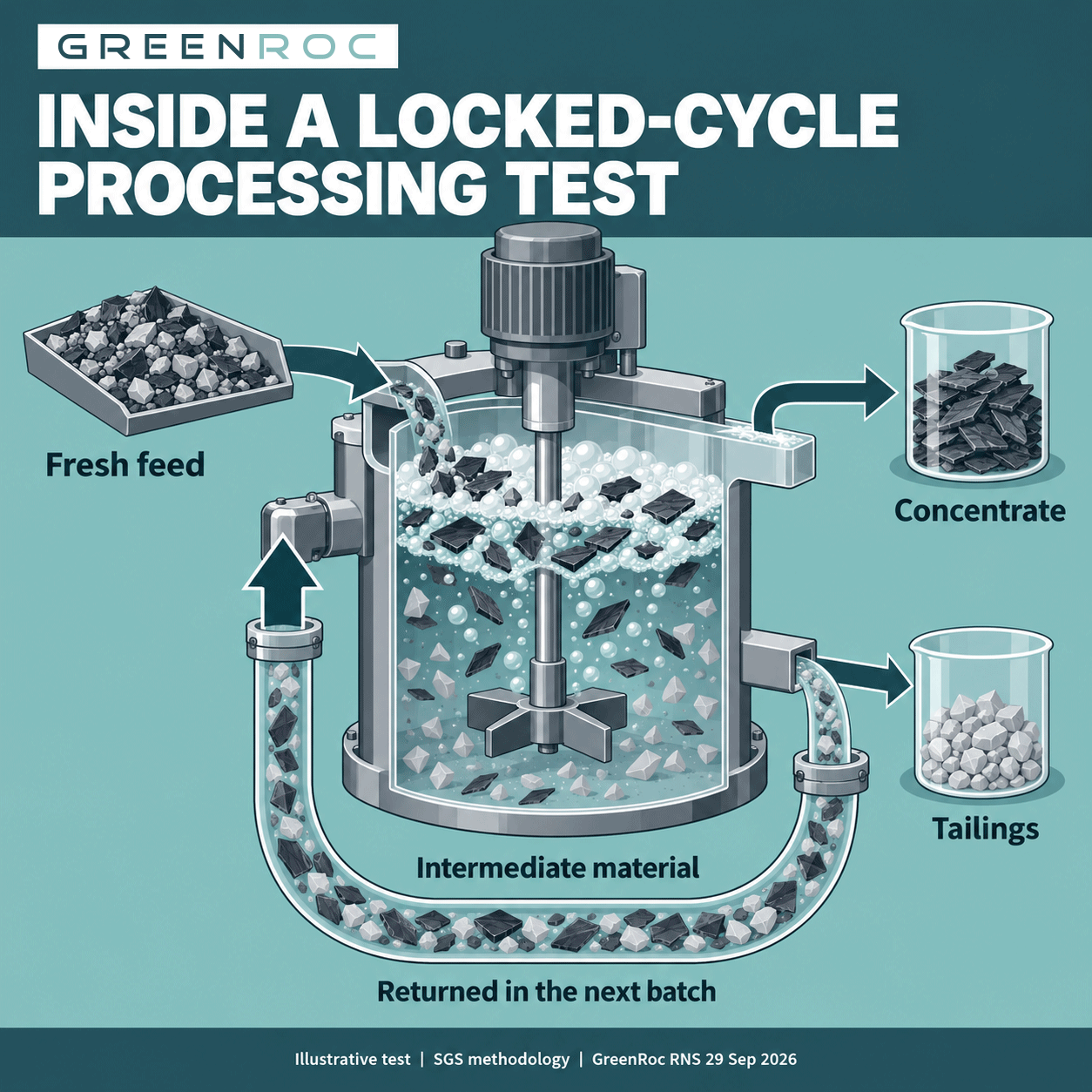
A processing circuit often sends some material around again. Understanding what happens to those returning streams helps engineers design a route that recovers the valuable mineral while producing a suitable concentrate.
In a typical flotation circuit, intermediate streams contain material that needs further treatment. They return to an earlier processing stage for another opportunity to separate the valuable mineral from the surrounding rock. Their composition and volume affect how the whole circuit behaves.
A locked-cycle test recreates this circulation through a sequence of laboratory batches. Material retained from one cycle is added at the appropriate point in the next, alongside fresh feed. Repeating the sequence allows engineers to investigate how the circuit approaches a stable balance, including whether material builds up within particular stages.
The final concentrate and tailings—the material leaving the circuit after separation—are collected, weighed and analysed. These measurements show where the valuable mineral ends up and help check whether the proposed flowsheet works as a connected system.
For Amitsoq, SGS Lakefield’s locked-cycle work helped define the flowsheet selected for the planned bulk-sample programme at GTK Mintec. It gives the larger processing run a tested starting point, including how material moves between stages and returns through the circuit.
#GreenRoc #Amitsoq #Graphite #MineralProcessing #Flotation #GraphiteConcentrate