
Natural vs synthetic graphite: two routes to the battery anode
Graphite Explained | Information for investors
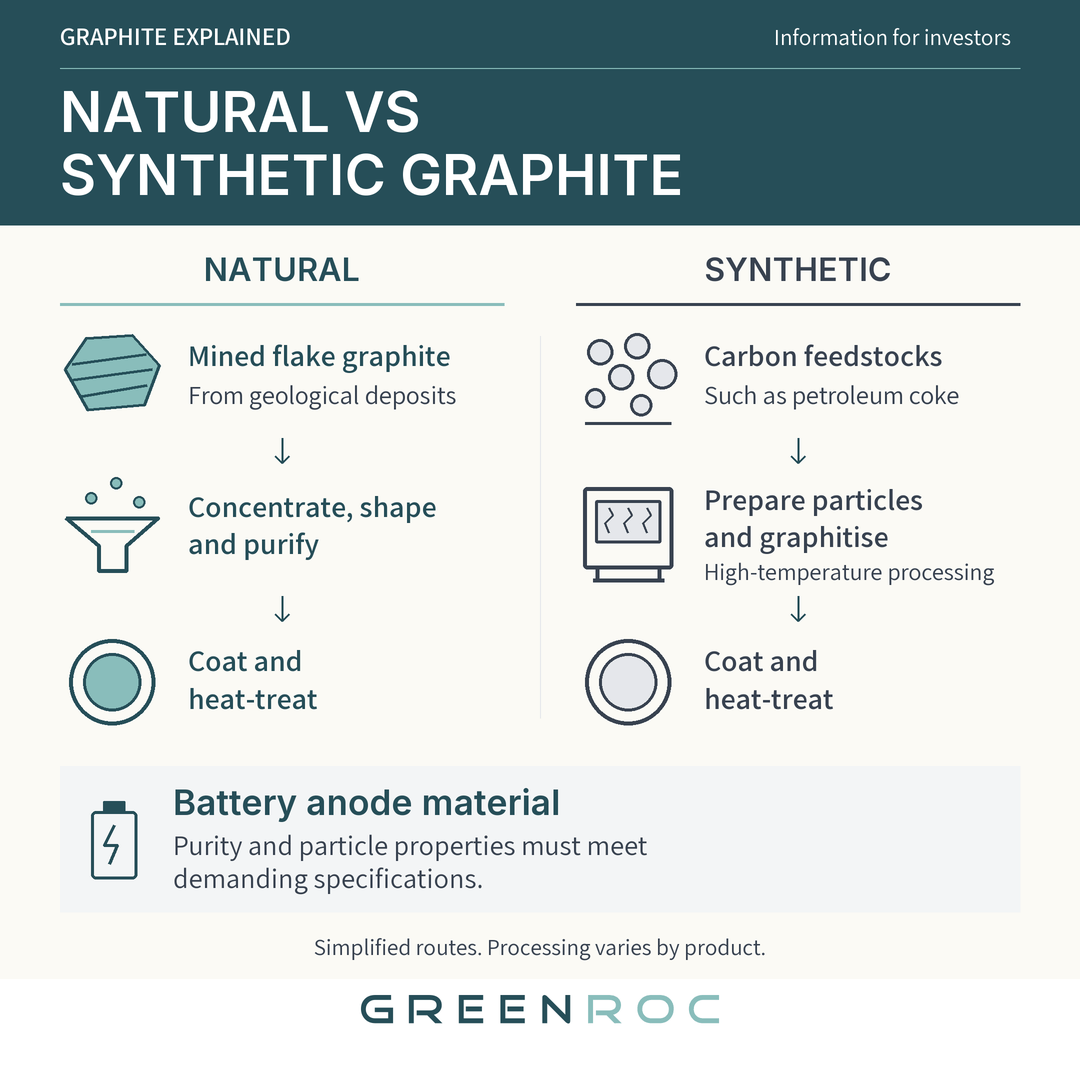
The graphite in a lithium-ion battery can begin as a mineral formed underground or as a carbon-rich industrial feedstock. Both routes can produce anode material, but they require different processing.
Natural graphite is mined from geological deposits. For battery use, flake graphite is concentrated, shaped, purified and coated, with heat treatment used during processing. The deposit’s mineralogy influences the impurities that need to be removed.
Synthetic graphite typically starts with carbon-rich feedstocks such as petroleum coke. Prepared particles undergo high-temperature graphitisation to develop the graphite structure, followed by finishing for the intended application. Both routes must meet demanding purity and particle specifications, which influence performance inside a battery.
The production route also affects the carbon footprint. Benchmark Mineral Intelligence’s life-cycle comparison of uncoated graphite anode material found lower greenhouse-gas emissions for the average natural graphite route than for the synthetic route. The results depend on the processing method and energy supply.
GreenRoc’s initial assessment estimates a cradle-to-gate carbon footprint of 1.60 kg CO₂e per kg of coated spherical purified graphite (CSPG) for its planned Amitsoq supply chain. This indicative model, not yet externally reviewed, gives the team a practical basis for comparing energy and processing choices and identifying opportunities to lower emissions as the project’s design advances.
At GreenRoc, we are developing Amitsoq’s natural flake graphite resource alongside our anode-material processing programme. As reported in August, our pilot plant’s particle-shaping circuits have been commissioned and tested using third-party graphite concentrate. This provides a practical platform for developing the processing steps needed for battery-anode applications.
#GreenRoc #GraphiteExplained #Graphite #BatteryMaterials #Amitsoq
Share your feedback
Discover